How Much Throat Space Do Viking Sewing Machines Have?
Viking sewing machine throat space varies by model, so check the distance from the needle to the machine body for the exact model you’re considering. More room can make it easier to roll and guide a larger quilt, but it doesn’t replace a frame or a longarm.
On this page (6 sections)
- How much throat space do Viking sewing machines have?
- What does throat space tell you about quilt size?
- How can you measure a Viking machine’s throat space?
- Which features matter alongside the measurement?
- What alternatives can you compare with a Viking machine?
- How can you decide if a Viking’s clearance is enough?
Throat spaces on Viking sewing machines vary by model. Check the needle-to-body distance for the specific machine, then consider how much quilt you need to roll into the space while stitching.
Viking is a brand with different machine models, so one number won’t describe them all. A machine’s throat space, sometimes called its harp space, is the clearance between the needle and the upright body of the machine.
That measurement helps you compare models, but it doesn’t tell the whole story. Quilt size, how you plan to quilt it, and the room around your sewing table all affect whether a given machine will work for you.
How much throat space do Viking sewing machines have?
There isn’t one throat-space measurement for all Viking sewing machines. Compare the needle-to-body clearance for the exact model, and confirm how the manufacturer defines its measurement.
Some machine descriptions give the length of the throat area, while others give the height or a general workspace measurement. Those numbers describe different things, so don’t compare them as if they were the same.
For quilting, the key question is how much fabric can sit to the right of the needle and still move freely. Check the Viking model’s manual or product specifications, and contact the manufacturer if the measurement or method is unclear.
A larger clearance can make it easier to bunch or roll a quilt without pushing the fabric against the machine body. It doesn’t mean the quilt will fit flat, and it doesn’t guarantee that a large quilt will be easy to maneuver.
What does throat space tell you about quilt size?
Throat space tells you how much fabric can fit between the needle and the machine body, not the maximum quilt size you can sew. A large quilt can be quilted on a standard machine in sections, though moving it through the throat takes planning.
The space you need depends on how you quilt. Straight lines across a quilt may call for frequent repositioning, while free-motion designs can require you to shift the quilt in several directions.
Start with the quilt’s width and the part you need to guide at one time. Fold or roll the quilt to estimate how much bulk will sit beside the needle, and leave room for your hands to steer it.
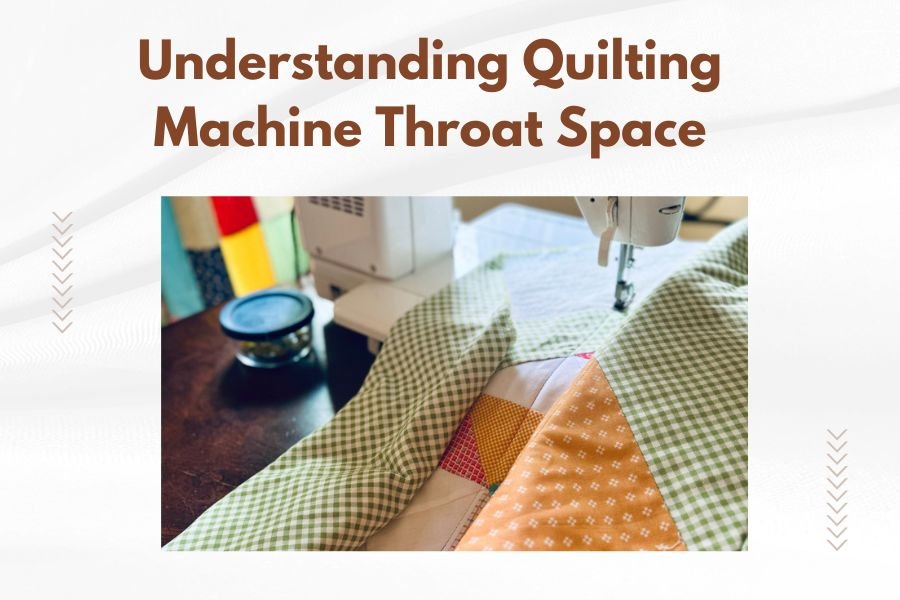
Our guide to How Much Throat Space Do I Need for Quilting? can help you decide what clearance suits your quilt plans. For a closer look at the measurement itself, see Understanding Quilting Machine Throat Space.
How can you measure a Viking machine’s throat space?
Measure from the needle to the closest part of the machine body on its right side. Use the same points when comparing different models, and write down the measurement with the model name.
- Turn off the machine and raise the needle.
- Measure horizontally from the needle’s center to the inside edge of the machine body.
- Record the measurement in inches.
- Check the manual for any additional workspace measurement, such as vertical clearance.
- Confirm that other models use the same measurement points before comparing numbers.
The needle-to-body distance gives a practical way to compare lateral clearance. A separate height measurement can help describe how much fabric can pass beneath the arm, but it is not interchangeable with the horizontal distance.
For a step-by-step explanation and tips for measuring consistently, use How to Measure Throat Space on Your Sewing Machine.
Which features matter alongside the measurement?
Look at the usable work area, table support, and quilting features alongside throat space. Those details affect how the quilt moves and how much support it gets while you stitch.
A wide table can support fabric around the machine, but it doesn’t increase the throat clearance itself. Check whether the table is included, how it attaches, and whether your sewing surface can support the quilt’s weight.
Consider the following before choosing a machine:
- Needle-to-body clearance: Check the exact model’s measurement and how it was taken.
- Work surface: A larger or detachable table can give the quilt more support.
- Quilting controls: Look for features that match your preferred method, such as drop feed for free-motion quilting.
- Room around the machine: Leave space to spread out and rotate the quilt.
- Quilt handling: Think about how often you’re willing to stop, reposition, or roll the fabric.
A larger throat can help with bulky quilts, but your table setup and quilting method still matter. For more options, compare our best large throat sewing machines for quilting.
What alternatives can you compare with a Viking machine?
Compare a Viking model with machines that offer features relevant to your quilting method, then verify each model’s throat measurement separately. The options below have useful quilting features, but the information here doesn’t establish their throat-space dimensions.
The Juki TL-2010Q is a single-needle lockstitch machine designed for straight stitching and quilting. Its knee lifter raises the presser foot without using your hands, and it can be used as a tabletop machine, mounted in some cabinets, or used on machine quilting frames.
The Brother CS7000X includes a wide table and quilt guide, and Brother describes its needle-to-arm workspace as larger. Check the model’s measured throat clearance if that dimension is central to your choice.
The Brother XR9550 includes a wide table and quilting foot, with drop feed for free-motion quilting and sewing. Its features may suit your preferred setup, but confirm the needle-to-body distance for the exact model before comparing it with a Viking machine.
How can you decide if a Viking’s clearance is enough?
Choose based on the largest quilt you plan to handle and the way you want to quilt it. Measure the model, test your setup with a folded blanket or scrap fabric, and decide whether the space lets you guide the fabric comfortably.
If you mostly quilt small projects, the throat clearance may be less of a concern than table support and ease of moving the fabric. For larger quilts, a wider throat can reduce how tightly you have to roll the quilt, but a larger table and a clear work area also help.
A machine with ample clearance still needs space around it. If your sewing area is tight, compare Best Sewing And Quilting Machine for Small Spaces and What Is the Best Size Quilting Machine for Small Spaces? before choosing a setup.
For Viking sewing machines, compare the exact model’s throat measurement rather than relying on the brand name. Pick the clearance that suits your quilt and quilting method, then use the same measurement points to compare machines.