9 Best Serger Sewing Machines for Beginners (November 2026)
The best serger sewing machines for beginners include the Brother 1034D Serger Overlock Sewing Machine for a first full-featured serger, the Brother Sewing Machine for learning standard sewing first, and the SINGER® Heavy Duty 4523™ Next Evolution Sewing for varied sewing projects.
On this page (8 sections)
- How we chose serger sewing machines for beginners
- Compare beginner sergers and sewing alternatives
- Serger sewing machines for beginners: the top picks
- What helps beginners learn serger threading?
- Which serger features matter for everyday fabric handling?
- Should a beginner buy a serger or a standard sewing machine?
- More guides on this topic
- How should you choose your first serger?
The best serger sewing machines for beginners offer clear threading guides and useful edge-finishing options. The Brother 1034D is the strongest fit here, while VEVOR adds a free arm and flexible thread setups, and MARGAR offers 12 stitch patterns with color-coded thread paths.
A serger trims and overlocks fabric edges as it sews. It can help finish seams on garments and knit projects, but it does not take the place of every standard sewing machine task.
If you’re deciding between machine types, start with our serger sewing machine vs sewing machine comparison. The picks below include sergers and several standard sewing machines, so check each product’s role before choosing.
Our picks at a glance
-
1
 Best for a first full-featured serger
Brother 1034D Serger Overlock Sewing Machine
9.7/10 our score
See it on Amazon -
2

-
3
 Best for varied sewing projects
SINGER® Heavy Duty 4523™ Next Evolution Sewing
9.5/10 our score
See it on Amazon
- 4
 Check it
Chunara Sewing Machine for Beginners
Best for simple sewing practice - 5
 Check it
Anitor Sewing Machine Carrying Case with Removable
Best for carrying a machine and supplies - 6
 Best for a colorful sewing machineCheck it
- 7
 Check it
MARGAR 2026 Serger Overlock Machine with 3/4
Best for multiple stitch patterns - 8
 Check it
VEVOR Serger Overlock Sewing Machine 1250 SPM
Best for sleeves and cuffs - 9
 Best for twin-needle practiceCheck it
How we chose serger sewing machines for beginners
We compared threading support, available thread setups, edge-finishing features, and fabric-handling options. We also included standard sewing machines that may fit beginners who want to learn general sewing before buying a serger.
Our score weighs specs and features against what you’re shopping for. The Brother 1034D leads for its threading aids and differential feed, while the other sergers offer different combinations of thread flexibility, visual guides, and workspace features.
Compare beginner sergers and sewing alternatives
The Brother 1034D, MARGAR, and VEVOR are the sergers in this group. The other picks are standard sewing machines or an accessory, which can still be relevant if you’re building a beginner sewing setup.
| Product | Best for | Our score |
|---|---|---|
| Brother 1034D Serger Overlock Sewing Machine | a first full-featured serger | 9.7 |
| Brother Sewing Machine | learning standard sewing first | 9.7 |
| SINGER® Heavy Duty 4523™ Next Evolution Sewing | varied sewing projects | 9.5 |
| Chunara Sewing Machine for Beginners | simple sewing practice | 9.4 |
| Anitor Sewing Machine Carrying Case with Removable | carrying a machine and supplies | 9.3 |
| SINGER® | a colorful sewing machine | 8.7 |
| MARGAR 2026 Serger Overlock Machine with 3/4 | multiple stitch patterns | 8.5 |
| VEVOR Serger Overlock Sewing Machine 1250 SPM | sleeves and cuffs | 8.2 |
| SnowVoice StitchMaster Pro | twin-needle practice | 8.2 |
Serger sewing machines for beginners: the top picks
The Brother 1034D is the leading beginner serger here, while the VEVOR and MARGAR provide alternate threading and fabric-handling features. Read the role and setup notes for each pick before deciding which one suits your projects.
Brother 1034D Serger Overlock Sewing Machine: Best for a first full-featured serger
- 3- or 4-thread serging
- Color-coded threading guides
- Lower looper threader
- Differential feed
Color-coded guides and a lower looper threader help make setup more approachable. Its 3- or 4-thread options and differential feed cover common edge-finishing tasks.
Pros
- Color-coded upper thread guide
- Lower looper threading system
- Differential feed for stretch or thin fabric
Cons
- Made for 120-volt use in the US
- A serger has a different role from a standard sewing machine
The Brother 1034D is the most complete beginner serger in this group. Its color-coded upper thread guide, lower looper threading system, and included instruction manual offer several cues as you learn setup.
It supports 3- or 4-thread serging and includes a lower looper threader. The differential feed is designed to improve results on stretch or thin fabrics, while the machine can handle multiple layers of denim and other heavy materials.
The 1034D includes standard, gathering, and blind stitch feet. It also offers overlock, narrow hem, rolled hem, and ribbon lock stitches; some additional stitch uses require optional presser feet.
Choose this if you want a dedicated serger with multiple threading aids and common edge-finishing options. It is intended for US use at 120 volts, so confirm your electrical setup before buying.
Brother Sewing Machine: Best for learning standard sewing first
- 27 built-in stitches
- Automatic needle threader
- Drop-in top bobbin
- Free arm
This is a standard sewing machine, not a serger, but it can be a useful first step if you want to learn seams and hems before adding overlocking.
Pros
- Automatic needle threader
- 27 built-in stitches
- Free arm for cuffs and sleeves
Cons
- Does not replace a serger for edge trimming and overlocking
- Made for 120-volt use in the US
The Brother XM2701 is a standard sewing machine for beginners who want to learn general sewing before adding an overlocker. Its 27 built-in stitches, automatic needle threader, and drop-in top bobbin support common sewing tasks.
A free arm helps with cuffs, sleeves, and pant legs. The machine includes six sewing feet and an automatic one-step buttonhole, which are features a serger does not replace.
This is not a serger, so it won’t trim and overlock an edge as you sew. For other standard machines, compare Juki HZL sewing machines.
It can be a better starting point if you need everyday seams and repairs, or if your plans include buttonholes and varied stitch types.
For more beginner options that combine sewing and quilting, see Best Sewing And Quilting Machine For Beginners and Best Quilting Machine For Beginners.
SINGER® Heavy Duty 4523™ Next Evolution Sewing: Best for varied sewing projects
- 23 built-in stitches
- Speed control
- Free arm
- Drop feed
This standard sewing machine offers speed control and a free arm for sewing tasks beyond edge finishing. It may suit a beginner who needs one machine for varied sewing and quilting work.
Pros
- Speed control for detailed sections
- Integrated needle threader
- Includes several sewing feet
Cons
- It is a sewing machine, not a serger
- Does not provide serger-style edge trimming
The SINGER Heavy Duty 4523 is another standard sewing machine, with 23 built-in stitches and speed control. That speed control lets you set a maximum speed for more control on curves, corners, and detailed sections.
Its free arm gives access to cuffs, hems, and smaller areas. Drop feed supports free-motion quilting and other techniques, while an integrated needle threader and top drop-in bobbin simplify setup.
It is not a serger, so choose it for general sewing and varied fabric work rather than automatic edge trimming. The included feet cover all-purpose sewing, buttonholes, zippers, and blind hems.
Chunara Sewing Machine for Beginners: Best for simple sewing practice
- 12 built-in stitches
- Two speed settings
- Foot pedal
- Free arm
The Chunara is a beginner-focused standard sewing machine with two speed settings and a free arm. It can help you practice basic sewing before choosing a separate serger.
Pros
- Two speed settings
- 12 stitch patterns
- Free arm for sleeves and pant legs
Cons
- Not a serger
- Product details do not specify serger-style edge finishing
The Chunara is a beginner-focused standard sewing machine with 12 stitch patterns and two speed settings. The free arm is designed for cylindrical items such as sleeves and pant legs.
A foot pedal lets you control sewing speed, and the machine also has a thread cutter, tension dial, and sewing light. These controls may make it a practical practice machine if you’re learning basic seams.
It is not a serger and does not replace a dedicated overlock machine for trimming and finishing raw edges. Choose it only if general sewing practice is the main need.
Anitor Sewing Machine Carrying Case with Removable: Best for carrying a machine and supplies
- Removable bottom padding
- Nylon bag
- Multiple pockets
- Padded shoulder strap
This carrying case is an accessory rather than a machine. Its removable bottom pad and pockets can help organize a compatible sewing machine and supplies for classes or travel.
Pros
- Removable bottom pad
- Several storage pockets
- Shoulder strap and carry handles
Cons
- Bag only, no machine included
- Check interior measurements against your machine
The Anitor carrying case is an accessory for transporting a sewing machine and supplies. It has removable bottom padding, multiple pockets, and a padded shoulder strap for carrying.
Its outer dimensions are 16.5 x 11 x 12.5 inches, with an inner size of 15.8 x 8.5 x 12 inches. Compare those measurements with your machine, especially if you plan to carry a serger, which may have a different shape from a standard sewing machine.
The case is bag-only, so it does not include a machine. It may suit a beginner who takes classes or wants one place for machine accessories.
SINGER®: Best for a colorful sewing machine
- 11 built-in stitches
- 1,100 stitches per minute
- Pink finish
- Four presser feet
This pink SINGER standard sewing machine supports everyday sewing with 11 built-in stitches. It is an alternative for beginners who need general sewing rather than a serger.
Pros
- 11 stitches with 69 applications
- Includes a quilting guide
- High sewing speed
Cons
- Not a serger
- Made for 110-volt use
The SINGER 4411 is a standard sewing machine with 11 built-in stitches and a pink finish. Its included quilting guide and presser feet support general sewing and craft projects.
It sews up to 1,100 stitches per minute and includes a soft cover. The machine is made for 110-volt use, so check compatibility before choosing it.
This is not a serger. Consider it if you want a standard machine for everyday sewing and prefer its color and accessory set over serger-style edge finishing.
MARGAR 2026 Serger Overlock Machine with 3/4: Best for multiple stitch patterns
- 3- or 4-thread capability
- 12 stitch patterns
- Color-coded thread paths
- Differential feed
Color-coded thread paths and a rethread guide give beginners visual setup cues. The 12 stitch patterns and adjustable differential feed offer options for edge finishing across different fabrics.
Pros
- Color-coded thread paths
- Supports 3- and 4-thread overlocking
- LED light
Cons
- Beginners are advised to follow the rethreading video guide
- No free arm is specified
The MARGAR serger offers 3- or 4-thread capability, 12 stitch patterns, and color-coded thread paths. Its rethreading instructions and video guide give beginners a visual reference for setup.
Differential feed is designed to help with lightweight and stretch fabrics. The machine also has adjustable cutting blades and a presser foot, along with an LED light for low-light work.
Beginners are advised to follow the video guide when rethreading. If you’re comparing models with air threading, read what to look for in serger sewing machines with air threading before choosing a setup style.
VEVOR Serger Overlock Sewing Machine 1250 SPM: Best for sleeves and cuffs
- 2-, 3- or 4-thread setups
- Color-coded threading
- Free arm
- Differential feed
The free arm is useful for sleeves and cuffs, while color-coded threading gives you a visual setup guide. Its 2-, 3- and 4-thread options suit beginners who want flexibility as their projects grow.
Pros
- Free arm for cuffs and sleeves
- Multiple thread setups
- LED lighting
Cons
- Several setup choices may take practice
- Maximum speed is 1,250 stitches per minute
The VEVOR serger supports 2-, 3-, or 4-thread setups, giving you several configurations for edge finishing. Color-coded threading and a free arm for cuffs and sleeves are useful features to compare as a beginner.
It also has differential feed, LED lighting, adjustable presser foot pressure, and a trim trap. Its stated maximum speed is 1,250 stitches per minute, so use the foot pedal to work at a pace that feels manageable.
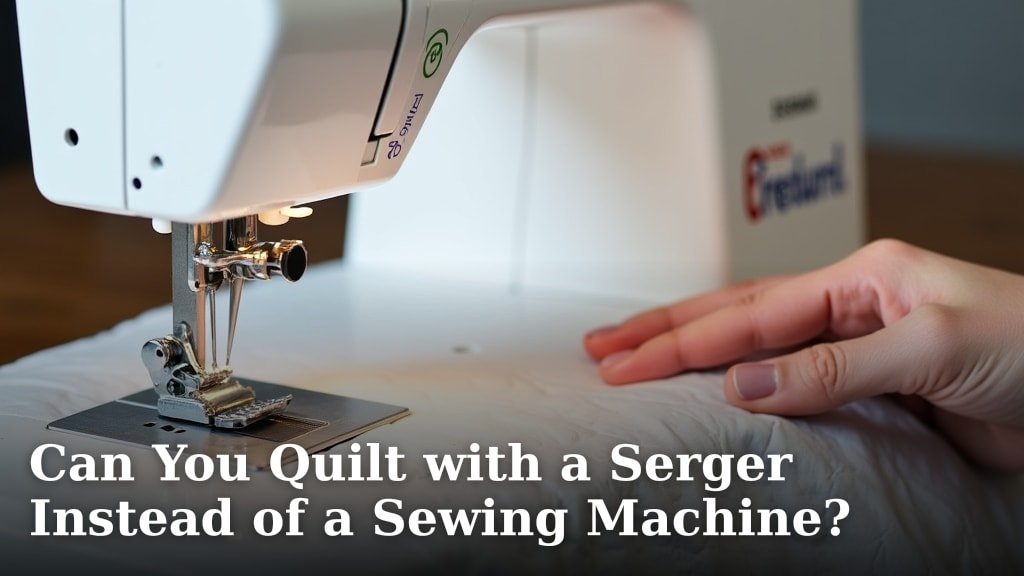
This model may fit someone who wants a free arm and a range of stitch styles, including rolled hem and lettuce hem. For quilting projects, first consider the limits of serger-based work with our guide to whether you can quilt with a serger instead of a sewing machine.
SnowVoice StitchMaster Pro: Best for twin-needle practice
- Two needle-thread combinations
- 16 stitch types
- Two speed settings
- Self-threading
The StitchMaster Pro is a standard sewing machine with twin-needle features, not a serger. It may suit a beginner looking for two parallel stitching lines and basic sewing controls.
Pros
- Two speed settings
- 16 stitch types
- Thread cutting function
Cons
- Not a serger
- Product details do not specify serger-style edge trimming
The SnowVoice StitchMaster Pro is a standard sewing machine with two needle-thread combinations and 16 stitch types. Its two speed settings let beginners choose a pace using the machine switch, or control speed with the pedal.
The product description also mentions self-threading, thread cutting, LED lighting, and a needle and thread drawer. These are sewing-machine features, not the same as the looper threading systems on a serger.
Choose it for standard sewing and twin-needle stitching rather than edge trimming. The listed functions do not guarantee the same serging setup as the dedicated overlock machines above.
What helps beginners learn serger threading?
Color-coded paths, a clear manual, and a threading system you can follow are useful when you’re learning a serger. The Brother 1034D and MARGAR both provide color-coded guidance, while Brother also includes a lower looper threader.
Threading is only one part of setup. Practice changing thread and testing stitches on scrap fabric before serging a finished garment, and keep the manual nearby when switching configurations.
If you’re comparing threading styles, our guide to serger sewing machines with air threading explains what to look for in that feature. Air threading is one option, while the picks here use other setup aids.
Which serger features matter for everyday fabric handling?
Differential feed and a free arm can help match a serger to the fabrics and garment sections you sew most. Differential feed appears on the Brother 1034D, MARGAR, and VEVOR, while the VEVOR has a free arm for cuffs and sleeves.
For knits or thin fabrics, a differential feed can help manage stretching or puckering during sewing. For garment details, a free arm makes it easier to reach small circular areas without bunching the rest of the piece.
Thread count also affects the seam setup. A 3- or 4-thread machine gives you common overlock choices, while VEVOR also offers a 2-thread configuration.
Should a beginner buy a serger or a standard sewing machine?
Buy a serger if your main goal is trimming and finishing fabric edges, and choose a standard sewing machine if you need a wider range of general sewing tasks. Some beginners eventually use both, but you can start with the machine that fits your current projects.
A standard sewing machine is usually more versatile for construction steps such as buttonholes and varied seams. A serger can finish edges quickly, but its threading and stitch setup require practice.
The serger vs sewing machine guide breaks down the difference by task. If quilting is your main goal, a standard machine may be a more direct fit than using a serger for every step.
More guides on this topic
- Juki MO-644D Serger Review
- Juki MO-1000 Serger Review
How should you choose your first serger?
Choose your first serger by matching threading help, stitch configurations, and fabric handling to the projects you plan to sew. The Brother 1034D is the clearest all-around beginner pick here, while MARGAR and VEVOR are alternatives with different setup and workspace features.
Pick the Brother 1034D if you want color-coded threading, a lower looper threader, and differential feed. Choose MARGAR if its 12 stitch patterns and rethread guide suit your learning style, or VEVOR if the free arm and 2-, 3-, and 4-thread options matter most.
If you still need buttonholes, general seams, or quilting functions, start with a standard sewing machine such as the Brother XM2701. Then add a serger when edge finishing becomes a regular part of your projects.
Our top 3 picks at a glance
-
1
Best for a first full-featured serger
Brother 1034D Serger Overlock Sewing Machine
9.7/10 our score
See it on Amazon -
2
-
3
Best for varied sewing projects
SINGER® Heavy Duty 4523™ Next Evolution Sewing
9.5/10 our score
See it on Amazon
Frequently asked questions
Do beginners need a serger or a sewing machine?
A standard sewing machine is usually the better first choice if you need basic seams, hems, buttonholes, and repairs. A serger trims and encloses fabric edges as it sews, so it can add a neat finish but has a different setup and purpose.
Choose based on the work you plan to do most.
Is the Brother 1034D easy for beginners to thread?
The Brother 1034D has a color-coded upper thread guide and a lower looper threading system, plus a lower looper threader. Those features provide setup cues, though you should follow the instruction manual when learning the threading path.
Practice with scraps before starting a project.
What should a beginner look for in a serger?
Look for clear threading guides, an instruction manual, and the thread configurations you'll use for your projects. Differential feed can help with stretch or thin fabrics, while a free arm is useful for cuffs and sleeves.
Make sure the machine's voltage suits your location.
Can a serger replace a sewing machine?
A serger can trim and overlock fabric edges, but it does not cover every task of a standard sewing machine. If you need buttonholes, many decorative stitches, or general repairs, a regular sewing machine may still be useful.
Compare the jobs each machine handles before buying.
Can you quilt with a serger?
A serger can join or finish fabric edges, but it is not a direct substitute for a sewing machine for most quilting tasks. Quilting often needs controls and stitch options designed for piecing or quilting.
Consider the techniques in your project before choosing a machine.