Which Extension Table Fits the Janome MC6650?
The best extension table for the Janome MC6650 is one that is made for this machine or clearly confirms its fit, with a stable surface that supports your quilt without blocking controls. Measure the machine area and compare the table's support dimensions before ordering.
On this page (11 sections)
- What should a Janome MC6650 extension table do?
- How do you check the Janome MC6650 fit?
- Is a machine-specific table better than a universal table?
- How much support does a quilting project need?
- What should you keep beside the table?
- Can a quilt pattern guide help you plan the work area?
- What can you use for temporary fabric organization?
- How do you set up a Janome MC6650 extension table?
- Why might the extension table wobble?
- How do you choose the right table for your sewing room?
- What is the final Janome MC6650 extension table decision?
The best extension table for the Janome MC6650 is one that confirms the machine fit and gives your quilt a level, supported surface beside the needle. A Janome-specific table is the simplest choice, while a universal table needs careful checks for its opening, height, width, depth, and support points.
The table should make the sewing area easier to use without covering controls or blocking access to the bobbin, presser foot, needle, or power connection. A large surface is not automatically a good fit if it sits too high, leaves a gap around the machine, or puts the weight of your quilt on an unsupported edge.
What should a Janome MC6650 extension table do?
A Janome MC6650 extension table should extend the flat sewing area while keeping the machine stable and the needle area easy to reach. The key test is fit at the machine, not the table's total size.
Quilting projects can spread well beyond the bed of the machine. For even layer feeding on this model, see MC6650 walking foot fit.
Extra support beside the needle helps you guide fabric with less of the quilt pulling downward, but the table still needs to match the machine's shape and height.
Look for these practical points:
- The table names the Janome MC6650 as a compatible machine, or gives measurements you can compare.
- The machine sits level with the table surface.
- The opening does not press against the machine or leave a large unsupported gap.
- The presser foot and needle remain visible and reachable.
- Bobbin access remains possible without removing the whole table.
- Controls, cables, and the power switch remain clear.
- Supports contact the sewing surface instead of resting partly on a mat or uneven edge.
- The table has enough depth for your quilt without taking over the entire sewing room.
The table does not need to be the largest option available. It needs to create a useful working zone around the MC6650 and carry fabric in a way that feels predictable as you sew.
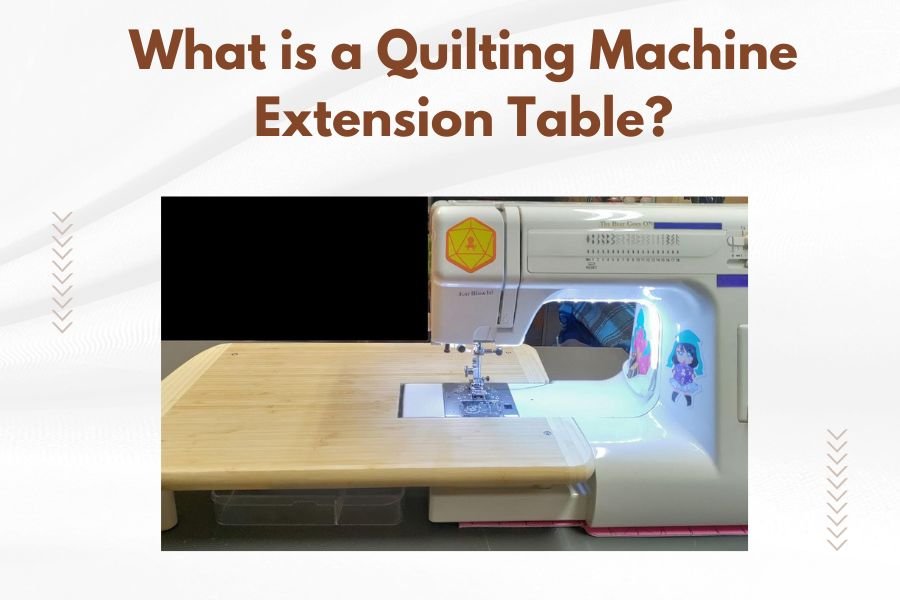
For a broader look at table shapes and uses, read What is a Quilting Machine Extension Table?.
How do you check the Janome MC6650 fit?
Check the Janome MC6650 fit by measuring the machine area first, then comparing those measurements with the table's opening and support layout. Do not rely on the words “universal” or “large” without checking the actual contact points.
Start with the machine unplugged and the presser foot lowered. Measure the height of the sewing bed from the surface where the table will sit, then measure the width and depth of the area the table must surround.
Record anything that affects the fit:
- The left and right edges of the machine bed.
- The space around the needle and presser foot.
- The location of the bobbin access.
- The handwheel and other controls.
- The power connection and foot-control cable.
- Any removable accessory that changes the machine's working shape.
- The edge of the sewing table where the extension table will rest.
Use the measurements to compare the table's opening, top height, total width, total depth, and support positions. A table can have the correct outer size and still fail if its opening does not match the machine bed.
Check the height especially closely. Even a small step between the machine bed and table can catch fabric, change how the quilt moves, or make the work surface uncomfortable to use.
If the table's dimensions are unclear, pause before ordering and confirm the exact figures with the seller or manufacturer. This is one of the few cases where a short measurement check can prevent a poor fit.
Is a machine-specific table better than a universal table?
A machine-specific extension table is usually easier to match to the Janome MC6650, while a universal table can work only when its opening and supports match your measurements. Choose the machine-specific option when you want fewer fit decisions.
A table made for the MC6650 should identify the machine model clearly. That does not remove the need to check your sewing setup, because your cabinet, table edge, and surrounding space still affect how the extension surface sits.
A universal table may offer more flexibility, but you must compare more details:
| Check | Machine-specific table | Universal table |
|---|---|---|
| Machine fit | The MC6650 should be named directly | You must confirm the opening and support layout |
| Height | Usually designed around the named machine | Must be measured against the machine bed |
| Setup | Often has a clearer placement method | May require more adjustment |
| Future use | May fit fewer machine models | May suit other machines if measurements match |
| Buying risk | Lower fit uncertainty | More responsibility rests on your measurements |
Universal does not mean one size fits every machine. It describes a broader intended use, not proof that every sewing machine will sit level or that every control will remain accessible.
If you are new to this type of accessory, compare the decision points in Best Extension Table For Beginners.
How much support does a quilting project need?
A quilting project needs enough support to keep the fabric from dragging the machine bed or pulling against your hands. The best support plan depends on the size, weight, and stage of your quilt.
A small block may need only a modest extension surface. A larger layered quilt can need support farther to the side and behind the machine, especially when the bulk collects near the needle.
Think about the project you sew most often:
- Small pieced blocks need a clear, level area near the needle.
- Long seams benefit from support that keeps fabric from falling off the side.
- Thick layered work needs a surface that does not flex under the quilt.
- Free-motion quilting needs room to move the project while keeping the needle area visible.
- Binding and narrow finishing work may not need the same footprint as a full quilt.
The extension table supports the project. It does not replace a larger cutting or pressing surface elsewhere in the room.
Position the sewing machine so the quilt can travel across the table without hitting a wall, lamp, shelf, or other machine. If the table is wide but your chair leaves you at an angle to the needle, the added surface may not improve control.
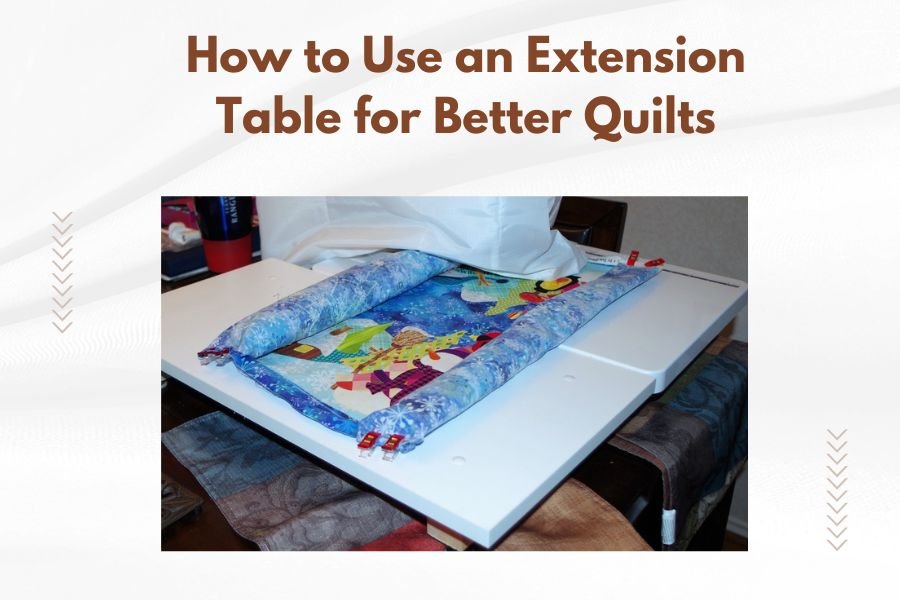
Our guide to How to Use an Extension Table for Better Quilts covers fabric support, hand position, and workspace choices in more detail.
What should you keep beside the table?
Keep only the tools you use during the current step beside the extension table. A clear area helps you move fabric without catching it on rulers, books, thread, or loose supplies.
Place scissors, clips, seam tools, and the project within easy reach, but keep them away from the needle path. Store cutting tools with their blades closed or covered when they are not in use.
A reference book can help when you need to check a sewing technique or plan a soft-furnishing project. Alison Smith's The Sewing Book is in English, has 352 pages, measures 9.31 x 1.13 x 11.19 inches, and covers more than 300 techniques with illustrated step-by-step sequences.
Its 3.82-pound weight and 9.31 x 1.13 x 11.19-inch dimensions make the storage location worth planning before you add it to a small sewing area. Keep it on a shelf or other stable surface rather than using the extension table as general storage.
The book was published by DK on February 4, 2025. Its description focuses on making clothing and soft furnishings with a sewing machine, so it can support general sewing knowledge around a quilting workspace without being an extension-table manual.
Can a quilt pattern guide help you plan the work area?
A quilt pattern guide can help you plan the size and sequence of a project, but it does not confirm whether an extension table fits your machine. Use the pattern to understand the fabric workload, then use measurements to choose the table.
Lori Holt of Bee in My Bonnet's It's Sew Emma Vintage Christ mas Quilt includes 42 vintage quilt block patterns and 28 total Christ mas projects and quilt patterns. The book has 206 pages, a soft cover, and spiral binding.
The patterns include 6-inch and 12-inch block sizes. That range can help you think through how much piecing and fabric handling a project may involve, but it does not tell you what size extension table your Janome MC6650 needs.
The book measures 11 x 9 x 1 inches and weighs 1.79 pounds. Store it beside the machine when you are working from it, but keep the extension surface clear enough for the quilt to move.
Use the project instructions to break work into smaller stages. Piecing, pressing, and quilting may each need a different amount of room, so you do not have to keep every tool and fabric piece beside the needle at once.
What can you use for temporary fabric organization?
For temporary organization, use a method that keeps fabric pieces together without placing loose items near the needle or feed area. A simple paper or cardboard labeling system can help separate pieces while you work through a block.
Elmer's All Purpose School Glue Sticks are acid-free, washable, photo safe, and nontoxic. The package contains 30 glue sticks, each 7 grams, and the sticks are designed for paper, cardboard, foam board, display board, and related craft uses.
The glue sticks apply smoothly without clumps and dry quickly and colorlessly. Their stated materials and uses are paper-based, so do not assume they are appropriate for attaching fabric or replacing a quilting-specific basting method.
Use them for labels, paper diagrams, or organizing notes away from the sewing needle. Keep any paper project pieces off the extension table when you need the whole surface for the quilt.
The package has a white color, plastic material, tube containers, and a medium viscosity level. It is not water resistant, so keep the sticks and any labeled paper away from wet areas.
How do you set up a Janome MC6650 extension table?
Set up the Janome MC6650 extension table with the machine unplugged, the table level, and every support point resting securely on the sewing surface. The final check is a slow fabric pass that confirms the quilt does not catch at the seam between machine and table.
Follow this order:
- Clear the sewing table and unplug the Janome MC6650.
- Place the extension table where you plan to use it.
- Check that the table does not rock before adding the machine.
- Position the MC6650 according to the table's fit instructions.
- Confirm that the machine bed and table surface are level.
- Check the needle, presser foot, bobbin access, controls, cables, and handwheel.
- Place a small fabric piece across the join.
- Move the fabric slowly in several directions.
- Add a larger quilt section only after the small test moves cleanly.
- Recheck the table if the project pulls, catches, or shifts.
Do not use a folded cloth as a permanent fix for a height mismatch. A soft layer can compress and make the table less stable as the quilt moves.
Keep the table free of dust, thread, and fabric scraps at the contact points. Small debris can change how a support rests and may create a wobble that was not present during the first setup.
For a step-by-step setup checklist, see How to Set Up an Extension Table?.
Why might the extension table wobble?
An extension table may wobble because its supports are uneven, the sewing surface is not level, the machine is not seated correctly, or fabric weight is pressing on an unsupported edge. Find the movement before sewing at speed.
Check the simplest causes first:
- Confirm that the sewing table itself is stable.
- Remove lint, thread, and fabric scraps from the support points.
- Make sure the machine sits fully inside the intended opening.
- Check that the table has not shifted away from the machine.
- Look for a gap or step between the machine bed and table.
- Move the quilt closer to the supported area.
- Confirm that cables are not pulling against the machine or table.
- Recheck the table after changing the project position.
A wobble can come from the room rather than the extension table. A folding table, uneven floor, or crowded cabinet may move when you guide a large quilt.
Do not continue if the table shifts toward the needle or if the fabric catches at the join. Stop, unplug the machine, and correct the support before resuming.
Read Why Is My Extension Table Wobbly? if the movement continues after the basic checks.
How do you choose the right table for your sewing room?
Choose the right table by matching the MC6650's fit first, then checking the surface size, support method, and available room around the machine. A table that fits the machine but blocks your chair or fabric path is still a poor choice.
Measure the sewing room before you choose a large surface. Mark the table's width and depth with removable tape, then sit in front of the marked area and imitate the movements you make while guiding a quilt.
Check these room details:
- Space for your chair and knees.
- A clear route for fabric on the left and right.
- Room behind the machine for quilt bulk.
- Access to the power connection.
- Space to remove the machine or reach the bobbin area.
- Lighting that reaches the needle and table join.
- Storage for books, fabric, and project notes.
- A stable floor and sewing surface.
If your room is small, a moderate table with accurate fit may be easier to use than a very wide table. You can support the rest of the quilt with a nearby surface, provided the fabric does not pull sharply against the needle area.
If you are comparing larger quilting workspaces, start with Best Extension Table For Quilters.
What is the final Janome MC6650 extension table decision?
The final Janome MC6650 extension table decision comes down to confirmed fit, level support, and enough room for the quilting work you actually do. **Pick a machine-specific table when you want the clearest compatibility path.
Pick a universal table only after comparing its opening, height, support points, and room layout with your measurements.**
A Janome-specific option is the better starting point for buyers who do not want to solve fit problems themselves. A universal option can make sense when its measurements are clear and the table leaves the MC6650 level, accessible, and supported.
Use the product boxes above as workspace aids, not as substitutes for a compatible extension table. The sewing reference supports technique learning, the quilt book supports project planning, and the glue sticks support paper organization.
Before ordering, measure the machine and the room, confirm the table's support dimensions, and check that the seller or manufacturer names the Janome MC6650 or provides enough measurements for a confident comparison. That process gives you a better answer than choosing by surface size alone.
Frequently asked questions
What extension table fits the Janome MC6650?
The right extension table fits the Janome MC6650's sewing area without covering controls, interfering with the presser foot, or leaving the quilt unsupported. Choose a Janome-specific table when possible, or compare the table's opening, height, width, depth, and support method with your machine before ordering.
Does the Janome MC6650 need an extension table for quilting?
The Janome MC6650 does not need an extension table for every quilting task, but a stable flat surface can support larger fabric and reduce the amount hanging from the machine bed. It is most useful when your quilt block or layered project needs more space beside the needle.
How do I measure for a Janome MC6650 extension table?
Measure the machine bed and the area around the needle, then note the height of the bed, the available width, and the depth you can spare on your sewing table. Also check where controls, cables, the presser foot, and the bobbin access sit before comparing a table's fit.
Can a universal extension table fit the Janome MC6650?
A universal extension table may fit the Janome MC6650 only when its opening, height, and supports match the machine. Universal sizing alone is not proof of compatibility.
Check the exact machine models named by the table's maker, then confirm the table will sit level and leave controls accessible.
How can I stop an extension table from wobbling?
Stop wobbling by checking that the table is level, its supports contact the sewing surface, and the machine sits fully inside the intended opening. Remove lint or fabric from contact points and avoid placing heavy quilt sections on one unsupported corner.
See the table's instructions for any adjustment steps.