9 Best Vintage Quilt Patterns (November 2026)
The best vintage quilt patterns include the Patricia Wilens for the widest pattern range, the Rita Weiss Traditional Patchwork Quilt Patterns for reusable templates, and the Jinny Beyer The Quilter's Album of Patchwork Patterns for pattern research.
On this page (7 sections)
- Which vintage quilt pattern book is best overall?
- The best vintage quilt patterns for different quilting goals
- How do you choose a vintage quilt pattern?
- How do vintage quilt patterns compare with modern patterns?
- What size vintage quilt should you make first?
- How should you prepare fabric for a vintage quilt?
- The best vintage quilt patterns for your next project
The best vintage quilt patterns combine traditional blocks, clear instructions and fabric choices that support an older quilt style. Our top pick is Patricia Wilens for its broad project range, while Rita Weiss is a better fit if reusable templates matter most.
Vintage style can mean several things. You may want a Civil War reproduction quilt, a 1930s design, an antique replica, or a scrap quilt with a collected look.
Each path asks for different fabric, block complexity and patience. A Civil War quilt often relies on muted reproduction prints, while a 1930s design may suit brighter period style fabrics.
A scrap quilt takes a different approach. It rewards quilters who own many small cuts and enjoy arranging them into a lived in surface.
Start by deciding the era and finished size. That choice narrows the shelves quickly and stops you buying fabric for a quilt you do not plan to make.
Measure the bed, wall or table where the quilt will live. Small projects test a pattern with less risk, while large projects need more fabric and seam accuracy.
Then use our guide to choosing fabric for a quilt to plan color, scale and quantity before cutting.
Sort your stash by light, medium and dark values before you start. That step shows whether you own enough reproduction fabric or need to fill gaps.
Check print scale next, because a tiny floral and a bold stripe can fight for attention. Mixing scales with care keeps a vintage quilt readable from across the room.
Plan the cutting method as well. Templates, rotary cutting and quick piecing each suit different blocks and sewing spaces.
Finally, set aside fabric for binding and backing at the start. Running short at the end is a common frustration that simple planning can prevent.
Our picks at a glance
-
1

-
2
 Best for reusable templates
Rita Weiss Traditional Patchwork Quilt Patterns
9.4/10 our score
See it on Amazon -
3
 Best for pattern research
Jinny Beyer The Quilter's Album of Patchwork Patterns
9.3/10 our score
See it on Amazon
- 4
 Check it
That Patchwork Place The Big Book of Civil
Best for reproduction-fabric quilts - 5
 Check it
Carol Hopkins Civil War Legacies II
Best for small traditional quilts - 6
 Best for block exchangesCheck it
- 7
 Best for antique scrap inspirationCheck it
- 8
 Check it
Liz Porter Marianne Fons Fons & Porter Presents
Best for historic replica projects - 9
 Best for 1930s quilt stylesCheck it
Which vintage quilt pattern book is best overall?
Patricia Wilens is the best overall choice because it offers more than 101 projects alongside guidance on quick piecing and rotary cutting. It gives you more room to change direction than a book tied to one era or project size.
Our score weighs pattern range, project usefulness, fabric flexibility and fit for shoppers seeking vintage quilt styles. The products appear from highest score to lowest score.
That order helps you compare makers with different needs. A high score signals a strong mix of variety, guidance and usable project ideas.
Patricia Wilens earns its place through breadth. More than 101 projects lets you sample several block families before settling on one style.
Quick piecing guidance matters for efficient construction. Rotary cutting guidance matters for cleaner cuts and faster preparation.
A broad book suits beginners still discovering their taste. It also suits experienced makers who want fresh block ideas without buying several focused titles.
The trade off is focus. If you already love Civil War reproduction fabrics, a narrower book may serve you better.
Use the ranking as a starting map, not a rule. Match the book to your stash, your space and the finished size you want to sew.
A quilter with limited storage may prefer a compact template book. A researcher may prefer a heavy reference that stays on the drafting table.
| Product | Best for | Projects | Length | Size | Our score |
|---|---|---|---|---|---|
| Patricia Wilens | the widest pattern range | More than 101 | 367 pages | 8.25 x 0.75 x 10.75 in | 9.5 |
| Rita Weiss Traditional Patchwork Quilt Patterns | reusable templates | 32 pages | 9.4 | ||
| Jinny Beyer The Quilter's Album of Patchwork Patterns | pattern research | 464 pages | 9.3 | ||
| That Patchwork Place The Big Book of Civil | reproduction-fabric quilts | Mini, lap and large bed-size quilts | 240 pages | 9.2 | |
| Carol Hopkins Civil War Legacies II | small traditional quilts | 80 pages | 8.8 | ||
| Betsy Chutchian | block exchanges | 112 pages | 8.6 | ||
| Edyta Sitar Patches of Scraps | antique scrap inspiration | 128 pages | 8.4 | ||
| Liz Porter Marianne Fons Fons & Porter Presents | historic replica projects | 24 | 208 pages | 8.2 | |
| Kay Connors | 1930s quilt styles | 96 pages | 7.9 |
The best vintage quilt patterns for different quilting goals
The best book depends on whether you want a broad reference, reusable templates, historic research, Civil War reproduction fabrics or small scrap projects. These picks are arranged by score, with each one suited to a different kind of vintage quilt maker.
Patricia Wilens: Best for the widest pattern range
- More than 101 projects
- 367 pages
- Quick piecing and rotary cutting guidance
A broad reference for quilters who want many classic designs in one book. It combines projects with practical guidance on quick piecing and rotary cutting.
Pros
- Largest project selection here
- Covers several quilting methods
- Useful as a long-term reference
Cons
- Published in 2001
- Too broad for a quilter seeking one focused era
Encyclopedia of Classic Quilt Patterns is the strongest starting point for a quilter who wants variety. It contains more than 101 projects and covers practical topics such as quick piecing and rotary cutting.
The 367-page format gives room to compare traditional looks before committing to one block family. That makes it useful when you want a vintage feel but have not settled on a specific era.
Its 8.25 x 0.75 x 10.75 in size is substantial enough to serve as a reference on a sewing-room shelf. The book is in English and was published by Oxmoor House.
Quick piecing suits quilters who want results with fewer seams to manage. Rotary cutting suits those who prefer precise cuts and a smoother workflow.
With more than 101 projects, variety is the main strength. You can move from simple piecing to more detailed traditional designs as your confidence grows.
That range helps you test fabric choices too. Try a block in reproduction prints, then try the same block in scraps.
The trade off is depth per era. A book this broad cannot give the same focus as a Civil War or 1930s collection.
Choose it for breadth and project ideas. If you want a small, tightly focused book with templates, Rita Weiss is the more direct choice.
Rita Weiss Traditional Patchwork Quilt Patterns: Best for reusable templates
- 27 patchwork designs
- 4 reusable cardboard templates
- 59 helpful illustrations
This compact book suits quilters who want traditional blocks without scaling or tracing patterns. The designs work with hand sewing or a sewing machine.
Pros
- Reusable templates
- Simple traditional blocks
- Works for hand sewing or machine piecing
Cons
- Only 32 pages
- Fabric colors are left for you to choose
Traditional Patchwork Quilt Patterns suits quilters who want classic blocks with less pattern preparation. Its 4 reusable cardboard templates support 27 designs without scaling up blocks or tracing each pattern.
The book works with traditional hand sewing or a sewing machine. That flexibility helps if you want to piece by hand while traveling or switch to machine piecing at home.
The 32-page format is compact, and the book weighs 4.8 ounces. Fabric colors are not fixed, so you can build a vintage look with light, bright, medium and dark fabrics that fit your stash.
Reusable templates suit quilters who dislike scaling patterns. They also suit group sewing, where several people can share the same block shapes.
Hand sewing suits slow evening work and travel. Machine piecing suits faster construction at a table with good light.
The 59 helpful illustrations support both approaches. They help you see how blocks sit together before you cut fabric.
With 27 designs, the range covers familiar favorites. Names in the book include Windmill, Ohio Star and Dutchman's Puzzle.
The trade off is scale of choice. At 32 pages, this is a focused tool rather than a full reference library.
Choose it for simple traditional patchwork and reusable templates. For a much larger block library, move up to Jinny Beyer's reference.
Jinny Beyer The Quilter's Album of Patchwork Patterns: Best for pattern research
- More than 4,000 pieced blocks
- Grid-based construction analysis
- Names, dates, photographs and indexes
A deep reference for quilters who want to identify, draft and resize traditional blocks. Its grid-based approach helps you understand how each design is built.
Pros
- Very large block collection
- Cross-references duplicate names
- Includes research and indexes
Cons
- Heavier than the other books here
- More reference-focused than project-focused
The Quilter's Album of Patchwork Patterns is best for quilters who want to study how traditional blocks are constructed. It contains more than 4,000 pieced blocks, with each design analyzed by the grid on which it is drawn.
That grid approach helps you recreate a block in a different size or color scheme. Original names, publication dates, cross-references, photographs, a bibliography and indexes make it useful for research as well as project planning.
At 464 pages and 4.65 lb, this is the heaviest book in the group. Keep it near your cutting or design area if you expect to compare blocks often.
Grid based drafting suits makers who like math and structure. It helps you understand why a block balances or why a seam line feels awkward.
Cross references help when the same block carries double names. That saves time when you search for a design you remember from another source.
Photographs of full quilts add context beyond single blocks. They show how a block reads when repeated across a surface.
The trade off is weight and focus. This is a research tool more than a short list of ready to sew projects.
Choose it when pattern discovery matters more than finished projects. For ready-to-make Civil War quilts, The Big Book of Civil War Quilts is more focused.
That Patchwork Place The Big Book of Civil: Best for reproduction-fabric quilts
- 58 patterns
- Mini, lap and large bed-size projects
- Designed for reproduction fabrics, scraps and precuts
This collection fits quilters drawn to history-rich blocks and reproduction fabrics. The range of project sizes makes it easier to match a pattern to your intended use.
Pros
- Broad project-size range
- Works with scraps and precuts
- Strong Civil War-era focus
Cons
- Focused on one historical style
- Intricate patterns may need more planning
The Big Book of Civil War Quilts is the best match for reproduction-fabric lovers who want options across several finished sizes. It includes 58 patterns for mini-quilts, lap quilts and large bed-size projects.
The book centers on history-rich quilts and popular Civil War-era blocks. It also works with scraps and precuts, which helps you use smaller cuts instead of planning every quilt from new yardage.
Choose it when the historical style and project range matter equally. If you mainly make wall hangings, doll quilts or gifts, Civil War Legacies II keeps the scale smaller.
Mini quilts suit wall display and quick completion. Lap quilts suit a sofa or reading chair and need less fabric than a bed size.
Large bed size projects ask for careful planning. Measure the bed first and confirm how much backing and binding you will need.
Scraps and precuts suit quilters who already own reproduction fabrics. Precuts can speed up cutting, while scraps add variety to the surface.
Traditional color combinations help keep the Civil War look. Light, medium and dark values create contrast without relying on bright modern prints.
The trade off is era focus. This book serves Civil War style best and offers less help for other periods.
Plan your fabric range before you cut. Sorting by value makes it easier to keep blocks balanced across a large quilt.
Carol Hopkins Civil War Legacies II: Best for small traditional quilts
- 17 small quilt patterns
- Suitable for scraps and 1860s reproduction fabrics
- Fabric-selection tips
A focused choice for small projects with a Civil War-era look. The fabric-selection tips help you build interest from scraps and reproduction prints.
Pros
- Good fit for small gifts
- Scrap-friendly projects
- Fabric-selection advice
Cons
- Not aimed at large bed quilts
- Narrower style range
Civil War Legacies II focuses on 17 small quilt patterns for scraps and 1860s reproduction fabrics. The projects suit wall hangings, doll quilts and gifts rather than large bed quilts.
Carol Hopkins includes “To Add Interest” tips about fabric selection. Those notes help you arrange mixed prints without losing the traditional look.
Choose this book when you want a manageable Civil War-style project. It is less suitable for a queen-size or large bed quilt, where a broader collection gives you more options.
Small quilts suit quilters with limited time. They can be finished in weeks rather than months and still teach important piecing skills.
Wall hangings need strong visual balance. Doll quilts need durable seams and a scale that suits small hands.
Gifts benefit from a clear finish and a manageable size. A small quilt is easier to mail and easier for a recipient to use.
Scraps suit this format well. Small blocks can use leftover reproduction prints that might be too small for a bed quilt.
The trade off is size range. If you want a large bed quilt, a broader collection gives you more layout options.
Store the book near your scrap bins. That placement makes it easy to match a pattern to fabrics you already own.
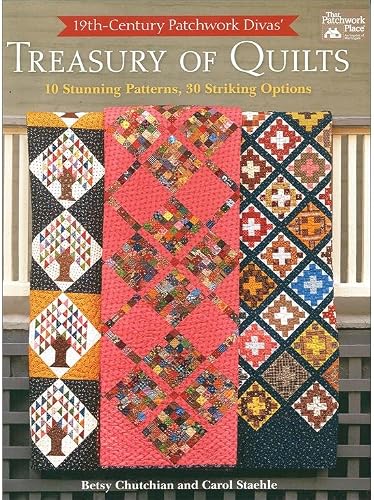
Betsy Chutchian: Best for block exchanges
- 10 patterns
- 30 quilt options
- 19th-century inspired blocks
This book suits quilters who enjoy detailed blocks and repeated design variations. The projects also fit a group block exchange using reproduction fabrics.
Pros
- Many variations from 10 patterns
- Strong 19th-century style
- Works for group stitching
Cons
- Intricate blocks need patience
- Less useful for modern-looking quilts
19th-Century Patchwork Divas' Treasury of Quilts offers 10 patterns and 30 quilt options, so each classic block can lead to several different project directions.
The book is built around 19th-century inspired quilts and reproduction fabrics. Its group-friendly approach also suits an ongoing block exchange, where several quilters work on related blocks.
Choose it for intricate historical blocks and variation. If your scraps are more varied than coordinated, Patches of Scraps offers stronger antique scrap inspiration.
Ten patterns with thirty options means variation sits at the center. A single block can become several quilts through layout and fabric changes.
That structure suits quilters who enjoy seeing one design in new settings. It also suits groups that want shared blocks with personal results.
A block exchange needs clear block sizes and consistent instructions. This book supports that kind of shared work with its pattern led format.
Reproduction fabrics carry the 19th-century look. Coordinated prints help intricate blocks read clearly from a distance.
Intricate piecing asks for patience and accurate seams. Pressing each section and checking block size as you go can prevent frustration.
The trade off is modern style range. Quilters seeking a modern look may find this collection too historically focused.
Choose it when you want detailed blocks and many variations from a small pattern set.
Edyta Sitar Patches of Scraps: Best for antique scrap inspiration
- 17 quilt patterns
- Gallery of 22 antique scrap quilts
- Designed for mixed fabrics and scraps
Scrap quilters get both project ideas and a gallery of antique quilts. The mixed-fabric approach suits makers who want a varied, collected look.
Pros
- Strong antique quilt gallery
- Good match for scrap stashes
- Patterns and visual inspiration together
Cons
- Mixed fabrics require color planning
- Less focused on one historical period
Patches of Scraps is the best choice for quilters who want antique scrap inspiration alongside new projects. It includes 17 quilt patterns and a gallery of 22 antique scrap quilts.
The gallery shows how many fabrics can work together in a collected design. To plan a deliberate color sequence, browse rainbow quilt patterns.
You can then use the patterns with your own mix of scraps and prints.
The gallery offers visual lessons beyond instructions. It shows how value, scale and spacing create a collected surface.
Scrap quilts suit makers with overflowing bins. They turn small leftovers into a quilt with texture and history.
Mixed fabrics ask for color planning. Without some order, many prints can compete instead of working as a group.
The 17 patterns give you a way to apply those lessons. You can repeat a block, mix blocks or use a layout that suits your stash.
The trade off is coordination. A scrap quilt needs more sorting than a quilt made from a controlled fabric range.
Sort scraps by value before you cut. Light, medium and dark groups make layout decisions faster and more confident.
Choose it when the visual character of antique scrap quilts matters as much as the instructions. For full-size historic replicas, Fons & Porter Presents Quilts from The Henry Ford is a better fit.
Liz Porter Marianne Fons Fons & Porter Presents: Best for historic replica projects
- 24 vintage quilt projects
- Full-size patterns
- More than 500 photos and illustrations
This collection is a strong fit for quilters who want to recreate historic quilts from The Henry Ford archives. It includes projects, variations, block charts and technique lessons.
Pros
- Full-size patterns
- Historic quilt focus
- Large visual reference section
Cons
- Replica work can take more time
- The collection centers on American quilt history
Fons & Porter Presents Quilts from The Henry Ford suits quilters who want to recreate historic quilts with detailed visual support. It includes 24 vintage quilt projects, full-size patterns, variations and block charts for scaling.
More than 500 photos and illustrations add historical context and show the projects clearly. The collection includes red and white quilts, Susan McCord quilts, log cabin quilts, appliqué quilts and patchwork quilts.
Choose it for replica projects and American quilt history. Its focus is more specific than a general vintage pattern encyclopedia, so it may be more book than you need for quick block practice.
Full-size patterns reduce preparation time. They also help you judge scale before you commit to cutting a large piece of fabric.
Block charts for scaling support different finished sizes. That flexibility helps when a historic design needs to fit a modern bed or wall.
Six technique lessons add skills beyond piecing. Topics include paper foundation piecing and binding with piping.
The timeline from 1825 to 1925 adds historical context. It helps you place each quilt style in a broader story of American quiltmaking.
The trade off is time and focus. Replica work can be slower than a simple block sample from a general book.
Choose it when history and replication matter more than quick practice. Start with one project and confirm your fabric plan before you proceed.
Kay Connors: Best for 1930s quilt styles
- 10 authentic 1930s patterns
- Hand-quilting patterns in each project
- Reproduction-fabric focus
Choose this focused collection if you want authentic 1930s-inspired projects with hand-quilting patterns built into the designs.
Pros
- Clear 1930s focus
- Hand-quilting guidance in projects
- Good match for reproduction fabrics
Cons
- Smallest pattern selection here
- Less useful outside the 1930s style
Fancy to Frugal is the best match for a quilter who wants authentic 1930s patterns. It contains 10 projects and incorporates hand-quilting patterns into every design.
The focused era gives the book a clear direction. Reproduction fabric helps carry the look, while the hand-quilting patterns add a period-appropriate step.
Choose it when the 1930s style is your main goal. For broader traditional design research, use Jinny Beyer's block reference instead.
Ten projects keep the scope manageable. You can finish several quilts without facing a library sized list.
Hand quilting patterns add a final layer to each design. They guide stitch placement and help the finished quilt match the period style.
Reproduction fabric suits this era well. Period style prints support the nostalgic look and help blocks read as historic rather than modern.
Intricate hand quilting asks for time and consistent stitch length. A simple hoop and good light can make the work more comfortable.
The trade off is era range. Quilters who want Civil War or 19th-century styles will need a different book.
Plan the quilting stage before you start piecing. Choose thread and marking tools that suit your fabric and your hand quilting habits.
How do you choose a vintage quilt pattern?
Choose a vintage quilt pattern by era, project size, block complexity and fabric plan. A broad book gives you more freedom, while a focused collection makes it easier to match a specific historical look.
Start with these four checks:
- Pick the era or style. Civil War books focus on 1860s reproduction fabrics, while Fancy to Frugal centers on 1930s patterns.
- Match the finished size. Small projects work well for wall hangings, doll quilts and gifts. Choose a larger collection for lap or bed quilts.
- Check the cutting method. Reusable templates can reduce preparation, while grid-based blocks help you draft different sizes.
- Plan the fabric mix. Scraps, reproduction fabrics and precuts suit different books. Sort your fabrics by value before cutting.
Quilters who want an easier starting point may also like these best beginner quilt patterns. They can help you build piecing confidence before trying intricate 19th-century blocks.
How do vintage quilt patterns compare with modern patterns?
Vintage quilt patterns emphasize traditional blocks, historical fabric looks and older construction styles. Modern quilt patterns often use simpler layouts, strong negative space or updated color plans.
That difference does not make one style better. Choose vintage patterns for reproduction fabrics, antique inspiration and classic block study, then explore the best modern quilt patterns if you want cleaner layouts or newer design language.
Vintage books can also support familiar motifs. If you enjoy geometric designs, learn how to quilt diamond patterns on your machine or explore how to quilt stars with easy machine patterns.
Vintage blocks often build a pattern through repetition. A simple star or log cabin can gain depth when many blocks sit side by side.
Modern patterns often place fewer blocks on a larger field of solid fabric. That approach creates breathing room and a cleaner visual line.
Fabric choice reinforces the difference. Reproduction prints support a vintage surface, while solid fabrics support a modern one.
Construction also differs in feel. Vintage piecing may ask for many small seams, while modern layouts may use larger shapes.
Neither path is easier in every case. Accuracy matters in both styles, and each style rewards careful pressing.
Choose based on the quilt you want to live with. A vintage quilt suits a traditional room, while a modern quilt suits a simpler interior.
You can also mix lessons from both styles. Use a vintage block in a modern layout or a modern color plan in a classic block.
What size vintage quilt should you make first?
A small vintage quilt is usually the easiest first project because it needs less fabric, fewer blocks and less time to finish. Wall hangings, doll quilts and gifts are practical choices when you want to test a pattern.
Civil War Legacies II is built around small projects, while The Big Book of Civil War Quilts includes mini, lap and large bed-size options. Measure your intended space before cutting, especially when a pattern offers several sizes.
For a larger finished quilt, compare layout and fabric planning with our guide to the best queen size quilt patterns. If the quilt will be donated, our best quilt of valor patterns can help you compare patriotic and service-focused designs.
How should you prepare fabric for a vintage quilt?
Prepare fabric by sorting it into light, medium and dark values, then check how prints look beside one another before cutting. Vintage-style quilts often depend on contrast between blocks, not just on matching colors.
Use scraps when the pattern supports them, especially for collections built around antique scrap quilts. Keep enough fabric aside for binding and replace any piece that is badly worn or unstable.
Follow the pattern's cutting order and label block parts as you go. Accurate seams matter more as blocks become intricate, so press each section consistently and compare finished units before joining rows.
Sorting by value is the first practical step. Lay fabrics in three groups and step back to see the balance.
Light fabrics give a quilt air. Dark fabrics anchor blocks and create strong points of contrast.
Medium fabrics connect the two groups. They keep a quilt from splitting into two separate worlds.
Check prints side by side at a distance. A print that looks sweet alone may overwhelm a smaller scale print.
Scraps work best when the pattern welcomes variety. Antique scrap collections often rely on many fabrics working together.
Replace worn or unstable pieces before you cut. A weak section can distort a block and weaken the finished quilt.
Keep binding fabric aside from the start. Binding needs a continuous strip, and running short can force a mismatch.
Label block parts as you cut them. Small labels prevent mix ups when a pattern uses similar shapes in different fabrics.
Use the pattern cutting order. That order often groups identical pieces and reduces mistakes.
Press each section in a consistent direction. Steady pressing helps seams sit flat and blocks measure correctly.
Compare finished units before you join rows. Catching a size problem early saves unpicking later.
The best vintage quilt patterns for your next project
The best vintage quilt pattern depends on the kind of making you want to do. Pick Patricia Wilens for the widest project range, Rita Weiss for reusable templates, Jinny Beyer for block research, or The Big Book of Civil War Quilts for reproduction-fabric projects across several sizes.
Choose Civil War Legacies II for small gifts, Patches of Scraps for antique scrap inspiration, Fons & Porter for historic replicas, or Fancy to Frugal for a focused 1930s style. Start with the book that matches your fabric stash and finished size, then plan the cutting method before you buy materials.
Patricia Wilens suits variety seekers. More than 101 projects support quick piecing and rotary cutting practice.
Rita Weiss suits template lovers. Four reusable cardboard templates support 27 traditional designs with less preparation.
Jinny Beyer suits researchers. More than 4,000 pieced blocks support grid based study and drafting.
The Big Book of Civil War Quilts suits reproduction fabric collectors. Fifty eight patterns span mini, lap and large bed sizes.
Civil War Legacies II suits small project makers. Seventeen patterns fit wall hangings, doll quilts and gifts.
Patches of Scraps suits scrap quilters. Seventeen patterns sit beside a gallery of 22 antique scrap quilts.
Fons & Porter suits replica makers. Twenty four projects include full-size patterns and historic context.
Fancy to Frugal suits 1930s fans. Ten projects include hand quilting patterns in each design.
Match the book to your stash before you buy fabric. A scrap book uses leftovers, while a reproduction book may ask for new prints.
Match the book to your finished size as well. Small projects finish faster, while large projects need more space and planning.
Then start with one pattern and one block. A finished block teaches more than a long list of planned quilts.
Our top 3 picks at a glance
-
1
-
2
Best for reusable templates
Rita Weiss Traditional Patchwork Quilt Patterns
9.4/10 our score
See it on Amazon -
3
Best for pattern research
Jinny Beyer The Quilter's Album of Patchwork Patterns
9.3/10 our score
See it on Amazon
Frequently asked questions
What are the best vintage quilt patterns for beginners?
Traditional patchwork designs with reusable templates are the easiest place to start. Rita Weiss includes 27 designs and 4 reusable cardboard templates, while Patricia Wilens covers quick piecing and rotary cutting across more than 101 projects.
Choose a pattern with simple block shapes before moving to detailed historical replicas.
What fabric works best for vintage quilt patterns?
Reproduction fabrics, scraps and precuts work well for many vintage-style quilts. Civil War collections often suit 1860s reproduction fabrics, while 1930s patterns call for fabrics that support that era's look.
Use our guide to choosing fabric for a quilt when you need help balancing color, scale and yardage.
Are vintage quilt patterns the same as antique quilt patterns?
Vintage quilt patterns recreate older styles, blocks or fabric looks, but they are usually newly published instructions. Antique quilt patterns refer to designs or quilts from an earlier period, while a modern book may explain how to make a new quilt inspired by them.
Check whether the book offers historical replicas, reproduction-fabric projects or general traditional blocks.
Which vintage quilt pattern book has the most designs?
The Quilter's Album of Patchwork Patterns has more than 4,000 pieced blocks, making it the broadest design reference here. Encyclopedia of Classic Quilt Patterns offers more than 101 projects and more practical project guidance.
Choose the album for research and block drafting, or the encyclopedia for a wider project mix.


