9 Best Panel Quilt Patterns (November 2026)
The best panel quilt patterns include the Suzanne McNeill Big Blocks for Layer Cake squares, the Fiberworks My Kinda Town Quilt Pattern for storybook wall quilts, and the Fabric Cafe Quick as a Wink for fast 3-yard layouts.
On this page (5 sections)
The best panel quilt pattern for most beginners is Panel Perfect 3-Yard Quilts, because it offers 8 layouts built around one panel and two additional 1-yard cuts. Choose Big Blocks for Layer Cake squares, or My Kinda Town for a detailed 42 x 54 in wall quilt.
Panel quilts are often quick to plan because the main image already gives you a focal point. The key decision is how much extra fabric you want around it.
A narrow border keeps attention on the panel, while squares, strips or larger blocks can turn the same center into a larger quilt top.
For fabric planning, start with our Quilting Fabric and Kits: The Complete Buying Guide. If your project is for a child, compare best baby quilt panels for boys before choosing a theme.
Our picks at a glance
-
1

-
2
 Best for storybook wall quilts
Fiberworks My Kinda Town Quilt Pattern
9.6/10 our score
See it on Amazon -
3
- 4
 Check it
Fabric Cafe Panel Perfect 3-Yard Quilts Book
Best for beginner panel layouts - 5
 Check it
Sue Voegtlin Quilt Block Genius
Best for custom block settings - 6
 Best for scrap-framed panelsCheck it
- 7
 Check it
Barbara Brackman Encyclopedia of Pieced Quilt Patterns
Best for historic block research - 8
 Check it
Anna Maria's Blueprint Quilting
Best for design-led layouts - 9
 Check it
That Patchwork Place Perfect Quilts for Precut Fabrics
Best for precut square borders
The best panel quilt patterns for different layouts
Panel Perfect is the most direct choice for a panel-centered quilt, while the other patterns help with Layer Cake squares, custom blocks, scraps and detailed wall designs. For crisp geometric layouts, compare Jaybird quilt patterns.
Pick the layout first, then match the book or pattern to your sewing style.
Suzanne McNeill Big Blocks: Best for Layer Cake squares
- 11 quilt patterns
- Layer Cake 10 x 10 in squares
- Step-by-step instructions
- Diagrams and variations
Big Blocks gives Layer Cake squares a simple starting point through large-block layouts. It suits beginners who want panel-style framing ideas built around coordinated precut squares.
Pros
- 11 patterns
- Beginner-friendly instructions
- Uses 10 x 10 in precut squares
Cons
- Focused on Layer Cake squares
- Not written specifically for fabric panels
Big Blocks is the best fit when your panel quilt will include 10 x 10 in Layer Cake squares. The book includes 11 beginner-friendly quilt patterns with step-by-step instructions, diagrams and variations.
For a small first project, see beginner baby quilt patterns.
Large blocks reduce the number of seams compared with a small-square design. That can help you keep the panel area visually clear while adding a simple pieced border around it.
Coordinated Layer Cake packs also make color planning easier.
This book is not written only for fabric panels, so you will need to adapt the center area if a pattern is built around squares. That flexibility is useful when your panel has a regular shape that can replace one large block or sit inside a broad border.
Use it when you already have Layer Cakes or want a quick layout with big visual sections. For smaller squares and more precut choices, compare Best Cotton Fabric Panels for Quilting with your panel size before cutting.
Fiberworks My Kinda Town Quilt Pattern: Best for storybook wall quilts
- 9 foundation paper pieced blocks
- Full-size templates
- Step-by-step instructions
- Finished size about 42 x 54 in
My Kinda Town is a detailed pictorial option for quilters who want a scene rather than a simple framed panel. Its 9 blocks form a 42 x 54 in wall quilt.
Pros
- Storybook town scene
- Full-size templates
- Decorative wall-quilt format
Cons
- Requires paper piecing experience
- More detailed than a basic panel layout
My Kinda Town is the best panel-style choice for a storybook wall quilt rather than a simple rectangular center. Its 9 foundation paper pieced blocks create a whimsical town scene that finishes at about 42 x 54 in.
The full-size templates help you build each detailed block, but paper piecing makes this a better match for experienced paper piecers and confident quilters. It is a project for someone who enjoys constructing an image from many smaller sections.
Use this pattern when the artwork is the main event and the finished piece will hang on a wall. It does not offer the simple one-panel-and-two-yards plan found in Panel Perfect, so allow more time for block construction and layout decisions.
Set up the blocks in order before sewing them together and check the scene as you go. That check helps you catch a reversed section while it is still easy to fix.
The finished size suits a wall display more than a bed quilt. Think about hanging space and a backing plan before you start cutting fabric for the blocks.
This choice suits quilters who enjoy detail and storytelling in fabric. If you prefer a quick framed center, a simpler panel layout will save time.
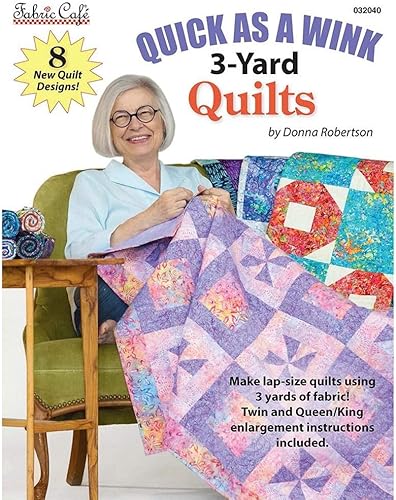
Fabric Cafe Quick as a Wink: Best for fast 3-yard layouts
- 8 quilt designs
- 3-yard quilt approach
- Lap, twin and queen/king size guidance
- Easy and quick layouts
Quick as a Wink helps you choose a layout when you want a fast quilt top from a small fabric plan. It offers 8 designs with guidance for several finished quilt sizes.
Pros
- 8 designs
- Simple 3-yard approach
- Multiple size guidance
Cons
- Not focused only on panels
- Specific panel measurements may need checking
Quick as a Wink is best when you want a fast 3-yard layout with more than one finished-size option. It includes 8 designs and explains how to make each pattern into a lap, twin or queen/king size quilt.
The 3-yard approach gives you a useful starting point for a panel project. A panel can serve as the focal fabric, while coordinating yardage supplies the surrounding sections.
Check the panel measurements against the selected layout before cutting. A panel that is wider or taller than the plan expects may change the border widths on each side.
Choose this book when you want a broader size plan than a small wall quilt. It is less specialized than Panel Perfect, so you may need to decide how the center image replaces or fits within the main fabric sections.
The size options make it handy for gifts or for using a panel that feels too small on its own. You can plan a lap quilt first and keep the same layout in mind for a larger version later.
Good fabric planning matters here because the surrounding cuts need to work with the printed center. Pull a small swatch from the panel and test it beside each coordinating fabric in daylight.
This book suits a quilter who likes clear structure without a rigid panel only formula. The trade off is a little extra measuring when the panel size does not match the pattern exactly.
Fabric Cafe Panel Perfect 3-Yard Quilts Book: Best for beginner panel layouts
- 8 panel quilt patterns
- One panel plus two 1-yard cuts
- Diagrams and fabric guides
- Directional-fabric-friendly layouts
Panel Perfect is the clearest match for quilters who want to frame a fabric panel with borders, squares or coordinating yardage. Each design uses three 1-yard cuts for a complete quilt top.
Pros
- Written for panels
- 8 layouts
- Directional fabric guidance
Cons
- Product size is listed as lap
- Layout choice depends on panel dimensions
Panel Perfect is the strongest choice for beginner panel quilt patterns. Each of its 8 designs uses one panel, or 1 yard of featured fabric, with two more 1-yard cuts for a complete quilt top.
The book is especially helpful when directional prints are part of your plan. Its layouts are designed with directional fabric in mind for Fabric #1 placement, which reduces the risk of turning a print upside down.
The listed size is lap, so check the finished dimensions you need before choosing a layout. Panel sizes vary widely, and a large image may need more surrounding fabric than a small center.
Read our guide on How to Quilt a Fabric Panel: Step-by-Step for the broader process from stabilizing the center through finishing. For more child-friendly ideas, see Best Baby Quilt Panels.
The simple fabric plan helps beginners focus on layout instead of maths. You can lay out the three cuts first and move them around until the panel stays the clear focus.
If the panel print has a strong direction, mark the top edge before you cut the companion fabrics. That small step makes it easier to keep the image upright through sewing and quilting.
This book suits a first panel quilt or a gift project with a set time frame. The main trade off is that you may need extra yardage when the panel itself is larger than expected.
Sue Voegtlin Quilt Block Genius: Best for custom block settings
- Over 300 pieced blocks
- 1,001 block variations
- No-math charts
- Mini-quilt settings and sampler patterns
Quilt Block Genius works when you want to build your own panel setting with pieced borders or square blocks. Its charts help resize grid-based blocks without doing the math yourself.
Pros
- Large block reference
- No-math charts
- Mini-quilt settings
Cons
- A reference book rather than a panel-only pattern
- More planning is required
Quilt Block Genius is best for a quilter who wants to design a custom border from square blocks. It includes over 300 pieced blocks that can become 1,001 blocks, along with no-math charts for resizing grid-based designs.
This is a reference for planning rather than a ready-made panel pattern. You can choose blocks that echo a color or shape in the center panel, then use the charts to work toward a border that fits your measured dimensions.
The expanded second edition adds smaller blocks for mini quilts, new settings and sampler patterns. That makes it useful for both a large framed panel and a smaller decorative project.
The no-math charts are the practical strength of this book for panel work. They help you resize a grid based block so the border can fit the center without trial and error at the cutting table.
A sampler style border works well when the panel has many small motifs. You can repeat a few blocks instead of using every design, which keeps the frame calm and the center easy to read.
This book suits a quilter who enjoys planning and wants control over the finished look. The trade off is time spent choosing and testing blocks before any sewing begins.
Keep a simple sketch of the panel measurements beside the book while you browse. That habit helps you judge scale faster and avoid blocks that are too busy for a narrow border.
Kelly Young Stash Statement: Best for scrap-framed panels
- 15 improv quilt patterns
- Panel, strip or block techniques
- Scrap organization ideas
- Cutting lists and finishing suggestions
Stash Statement suits quilters who want to surround a focal panel with organized scraps instead of matching yardage. The panel, strip and block methods give you several ways to control an improv layout.
Pros
- 15 patterns
- Uses scraps and strips
- Includes cutting lists
Cons
- Improv approach needs design judgment
- Not every project is a framed panel quilt
Stash Statement is the best option for scrap-framed panels. Its 15 structured improv patterns use panel, strip or block techniques, so you can build a border from fabrics already in your stash.
The book also includes organization ideas, materials lists, cutting lists and finishing suggestions. Those details matter when the border will combine fabrics with different widths or print scales.
Choose it if you like controlled improvisation instead of repeating the same square around all four sides. The trade off is that you must make more design decisions than with a fixed panel pattern.
The panel method suits a quilter who wants the center to stay intact while the edges grow from scraps. The strip and block methods give you more movement if the panel is smaller than the border area you want.
Organization is a key part of using this book well. Sorting scraps by color or size before you cut can make the border feel planned rather than random.
This approach works best when your stash has enough variety to support the frame. If the scraps are mostly very dark or very light, use them sparingly so the panel remains the focus.
It suits confident beginners and experienced quilters who enjoy creative freedom. Keep the layout on a design wall while you work so you can step back and check balance.
Barbara Brackman Encyclopedia of Pieced Quilt Patterns: Best for historic block research
- Over 4,000 pieced block patterns
- Line drawings and color suggestions
- Pattern names and publication sources
- Third edition
This encyclopedia is useful when your panel needs a traditional square-block border. Search by layout or construction information, then use the block ideas to plan a custom frame.
Pros
- Very large pattern reference
- Color suggestions
- Historic pattern information
Cons
- Not a step-by-step panel book
- Best for research and planning
The Encyclopedia of Pieced Quilt Patterns is best for researching traditional blocks that can frame a modern panel. It includes over 4,000 pieced block patterns with line drawings, color suggestions, names and publication sources.
Use the book to find a square that matches a motif in your panel, such as a star, point or chain shape. For another traditional look, browse Amish quilt patterns.
Then plan the border around the block's grid and your measured center. Note the finished block size first, then work out how many blocks fit along each side.
This is not a beginner panel pattern with a fixed cutting plan. It is better for quilters who enjoy comparing blocks and building a personal layout from a strong visual idea.
The line drawings help you judge the structure of a block without color getting in the way. That is useful when you want a traditional shape to echo the panel without copying its palette exactly.
Publication sources add depth if you enjoy the history behind a block name. That detail can help you choose a design that feels connected to the theme of your center fabric.
This book suits a research led approach rather than fast sewing. The trade off is that you will do the measuring and layout planning yourself.
Keep a short list of candidate blocks and test them at a small scale beside the panel. A quick paper or fabric mock up can show whether the border will support the center or compete with it.
Anna Maria's Blueprint Quilting: Best for design-led layouts
- 16 quilt and patchwork projects
- 4 design structures
- Color and scale guidance
- QR codes linked to technique videos
Blueprint Quilting helps you plan a panel quilt around color, pattern and scale. It fits quilters who want to adapt a focal image into a more personal layout.
Pros
- 16 projects
- 4 underlying structures
- Color and scale ideas
Cons
- Not dedicated to fabric panels
- Adaptation takes more design work
Blueprint Quilting is best for design-led panel layouts. Its 16 projects use 4 underlying design structures, with guidance on color, pattern, scale and technique.
A fabric panel can act as the visual anchor while the surrounding fabrics follow one of those structures. This approach suits a quilter who wants the finished quilt to feel designed around the image rather than simply bordered.
The book requires more interpretation than Panel Perfect. Choose it when you are comfortable adapting colors and proportions, especially if your panel has several strong colors that need careful balancing.
For another project that uses panels as the focus, compare Best Christmas Fabric Panels for Quilting.
The four structures give you a framework instead of a single fixed layout. That makes the book useful when a panel has an unusual shape or when you want the border to add rhythm rather than repeat a simple frame.
Color guidance matters a lot with this approach. Test the panel against a few fabric groupings and keep notes on which colors soften the image and which ones sharpen it.
Scale is another place to slow down before cutting. A large print border can overwhelm a small panel, while a smaller print can add detail without taking over the scene.
This book suits a quilter who likes to design as they sew. The trade off is more decision making than a pattern written only for panels.
That Patchwork Place Perfect Quilts for Precut Fabrics: Best for precut square borders
- 64 quilt patterns
- Fat quarter patterns
- Charm square patterns
- Jelly Roll and Layer Cake patterns
Perfect Quilts for Precut Fabrics gives you the widest pattern pool for adding coordinated squares around a panel. Organize the projects by precut type before choosing a border layout.
Pros
- 64 patterns
- Several precut formats
- Large reference book
Cons
- Not panel-specific
- You may need to adapt the center area
Perfect Quilts for Precut Fabrics is best for precut square borders and broad pattern research. It includes 64 designs organized around fat quarters, charm squares, Jelly Rolls and Layer Cakes.
That range makes it useful when you own precut fabric but have not chosen a border layout yet. Find a square-based design that fits your panel's proportions, then check whether the center can replace the pattern's main section.
The trade-off is adaptation. This book is not dedicated to panels, so measure the center carefully and plan the border width before cutting the precuts.
The range of precut formats helps you start with what you already own. Charm squares suit a small pieced frame, while Layer Cakes can create bolder sections around a larger center.
Organization by fabric type makes browsing faster. You can narrow the choice to patterns that match your precut size instead of reading every design in detail.
A mock up on a flat surface is worth the time with this book. It shows whether the panel will sit well in the center section or whether the border needs to be wider on one side.
This choice suits a quilter with a stash of coordinated precuts and a panel waiting for a plan. The trade off is that the center adaptation needs careful measuring before sewing.
How do you compare panel quilt patterns with squares?
The best panel quilt patterns with squares balance the panel width against block size and border strips. A layout can become difficult if the panel is not square or the blocks do not divide evenly into the space.
Measure the center before choosing a pattern and record its width and height. Then decide whether the panel should stay fully visible or sit inside a frame that adds structure.
Use squares for a repeated rhythm around the image. Use strips to correct a small size difference or when the panel already has enough detail.
Width and height can differ by a small amount. That difference can change how many blocks fit along the top compared with the sides.
Block size decides the rhythm of the border. Small squares create a busy frame, while large blocks give a calmer edge and fewer seams.
Border strips can solve uneven spacing between squares and the center. A narrow strip can separate a busy panel from a busy border.
If the space does not divide into whole blocks, adjust the block size or add a strip before cutting. Check fabric direction too, since directional prints in squares need to face the same way.
Quilt Block Genius and Perfect Quilts for Precut Fabrics offer the most room for custom square planning. Big Blocks is easier when your precuts are already 10 x 10 in Layer Cakes.
Set up the full border before sewing and compare balance on all four sides. Keep the panel pressed and squared first, so seams match and squares sit flat.
What fabric works best around a quilt panel?
The best fabric around a quilt panel usually repeats one color from the image without competing with its main shapes. A quieter print can create a clean frame, while a small scale print can add texture without breaking up the picture.
Check print direction before cutting. Panel Perfect is especially useful for directional fabrics because its layouts account for Fabric #1 placement.
Compare the panel value as well. If the center is dark, a lighter border can separate it, while a deeper border can give a light panel a clearer edge.
The fabric choice should support the center rather than hide it. Read Best Riley Blake Fabric Panels for Quilting if you are choosing a branded panel collection and want to plan coordinating fabric around it.
Start with one color that appears in the panel and use it in the border. Then check whether that fabric feels calm beside the print.
Value contrast helps the center stand out. A border close in value can blend into the panel, while a clearer contrast gives the image a defined edge.
Print scale also changes the mood of the frame. Small prints add texture from a distance, and larger prints can restate a motif in a bolder way.
Mark the top of each directional piece and lay them out in order before cutting. Consider texture and weight too, since a fabric that feels very different can change how the quilt drapes.
Test choices in daylight and step back to check the balance. Keep a small record of the fabrics used, so you can buy more yardage later if needed.
How do you set up a panel quilt before sewing?
Start by pressing the panel, then measure it after pressing. Keep the panel flat while you mark the center and check the corners.
Trim only after you understand how much fabric the border requires. Removing even a small amount can change the center size and affect the final strips or squares.
Lay out the panel, borders and blocks on a flat surface before sewing. This helps you spot directional prints, repeated colors and mismatched values while pieces can still be moved.
For a simple beginner setup, Panel Perfect uses one panel or 1 yard of featured fabric plus two 1-yard cuts. For a more custom setup, choose blocks from Quilt Block Genius and calculate the border around the measured center.
Pressing comes first because heat and moisture can change the size of printed fabric. Measure after pressing so the numbers match the panel you will actually sew.
Mark the center line and the top edge before you trim anything. Those marks help keep directional prints upright and give a reference point for border seams.
Check each corner with a ruler or square while the panel is flat. A corner that pulls to one side can make the first border strip sit at an angle.
Dry lay every border piece and move them until color balance feels even on all four sides. Pin or label pieces by side if the layout is complex.
Measure again after the first border is sewn on. Small changes can happen at each seam, and a fresh measurement helps you cut the next side to fit.
Which panel quilt pattern should you choose?
Choose Panel Perfect 3-Yard Quilts if you want the clearest instructions for framing panels with borders and coordinating yardage. Choose Big Blocks if you already have Layer Cake squares, or My Kinda Town if you want a detailed wall quilt built from paper-pieced blocks.
For custom square borders, use Quilt Block Genius. For scrap fabrics, use Stash Statement.
If you want a wider reference library, Perfect Quilts for Precut Fabrics gives you 64 precut-based designs.
The best panel quilt patterns match your center measurements and your preferred amount of planning. Measure first, choose the border style second, and cut only after the full layout is clear.
Start with the panel size and the finished size you want. Those two numbers will rule out some patterns and make the right choice easier to see.
If you want a fast start, Panel Perfect gives you a simple fabric plan and clear placement guidance. It suits a beginner who wants the panel to stay front and center.
If you already own Layer Cake squares, Big Blocks may fit your stash better than a yardage based plan. Large blocks keep the layout calm and reduce the number of seams around the center.
If the panel is part of a detailed scene, My Kinda Town offers a different kind of project. That pattern suits a wall hanging where the picture itself is the main reward.
For a border built from square blocks, Quilt Block Genius gives you charts and a wide block library. For scraps, Stash Statement offers structured improv methods that can surround a panel with fabric you already own.
Measure the panel, test the border layout on a flat surface, and check print direction before cutting. That short setup step will help the finished quilt look balanced and keep the center fabric as the focus.
Our top 3 picks at a glance
-
1
-
2
Best for storybook wall quilts
Fiberworks My Kinda Town Quilt Pattern
9.6/10 our score
See it on Amazon -
3
Frequently asked questions
What is the best panel quilt pattern for beginners?
Panel Perfect 3-Yard Quilts is the strongest beginner choice because it is written for panels and uses one panel or 1 yard of featured fabric with two additional 1-yard cuts. Its diagrams and fabric placement guidance help you plan borders without guessing at the layout.
Can you use squares with a fabric panel?
Yes, squares can frame a fabric panel or create a pieced border around it. First measure the panel, then choose square blocks or precut pieces that bring the finished border close to the panel width.
Big Blocks and Perfect Quilts for Precut Fabrics are useful references for square-based layouts.
How do you choose fabric for a panel quilt?
Choose border fabric by pulling a color from the panel, then check value and print scale before cutting. Directional prints need extra attention because the design must face the same way.
Our guide on how to choose fabric for a quilt covers the planning process.
Do panel quilts need borders?
No, a panel can be quilted on its own, but borders add size and can make the center image stand out. Use narrow strips for a clean frame, squares for a pieced edge, or wider coordinating cuts when the panel needs to become a larger quilt top.
How do you square a fabric panel before sewing?
Measure the panel from several points and trim carefully so the corners are square before adding borders. A square center makes the next seams easier to match.
Read How to Square Up a Quilt Block? before cutting your framing pieces.


