
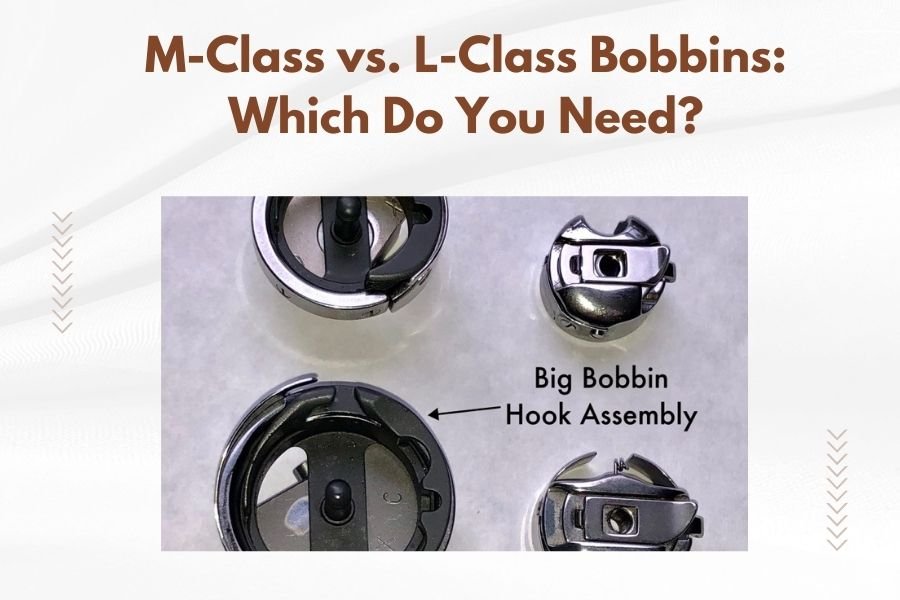
M-Class bobbins are smaller and used in home sewing machines, while L-Class bobbins are larger and designed for industrial or heavy-duty quilting machines.
The main difference between M-Class vs. L-Class bobbins is their size and capacity – M-Class holds about 60-80 yards of thread, L-Class holds 120-150 yards.
You’re standing at your quilting machine, ready to start a big project. Then you realize your bobbin is almost empty. Again. Sound familiar?
Picking the right bobbin type can save you time and frustration. Let me walk you through what makes these two bobbin classes different.
What Are M-Class and L-Class Bobbins?
Think of bobbins like spools that live under your sewing surface. They hold the bottom thread that locks with your top thread to create stitches.
M-Class bobbins measure about 20.5mm in diameter. They’re the standard size for most home sewing and quilting machines. You’ll find them in brands like Brother, Janome, and Pfaff.
L-Class bobbins are bigger at roughly 27mm in diameter. They’re built for industrial machines and high-volume quilting work.
Size Matters More Than You Think
The size difference isn’t just about looks. A larger bobbin holds more thread. More thread means fewer interruptions when you’re in your quilting zone.
I found that many quilters don’t realize how much time they spend changing bobbins. On a large quilt, you might change an M-Class bobbin 8-10 times. With L-Class, that drops to 4-5 changes.
Thread Capacity Comparison
Here’s where the rubber meets the road. Thread capacity affects your workflow more than any other factor.
| Bobbin Type | Thread Capacity | Typical Use |
|---|---|---|
| M-Class | 60-80 yards | Home quilting, garment sewing |
| L-Class | 120-150 yards | Industrial quilting, long-arm machines |
Real-World Impact on Your Projects
Let’s say you’re quilting a king-size bedspread. That’s roughly 1,200 linear feet of quilting lines.
With M-Class bobbins, you’ll stop about 15-20 times to reload. With L-Class, you’re looking at 8-10 stops. That’s half the interruptions.
Time Savings Add Up
Each bobbin change takes about 2-3 minutes when you factor in stopping, changing, and getting back into rhythm. On big projects, L-Class bobbins can save you 30-45 minutes.
Machine Compatibility Guide
You can’t just swap bobbin types. Your machine’s bobbin case is designed for one specific size.
Common M-Class Machines
- Brother quilting machines (most models)
- Janome Memory Craft series
- Pfaff creative and quilting lines
- Singer quilting machines
- Babylock quilting models
Typical L-Class Machines
- APQS long-arm quilting machines
- Gammill quilting systems
- HandiQuilter long-arm models
- Tin Lizzie quilting machines
- Industrial Juki quilting machines
How to Check Your Machine
Look at your current bobbin. Measure it with a ruler. M-Class bobbins are about the size of a quarter. L-Class bobbins are closer to the size of a half-dollar.
Your manual will also tell you which class your machine uses. When in doubt, contact your dealer.
Cost Differences You Should Know
L-Class bobbins cost more upfront. You’ll pay about $2-4 per L-Class bobbin versus $1-2 for M-Class.
But here’s the twist. L-Class bobbins often save money in the long run.
The Hidden Economics
You need fewer L-Class bobbins to keep multiple projects going. Many quilters keep 10-15 M-Class bobbins wound with different thread colors. With L-Class, you might only need 6-8.
Plus, less thread waste. When you change bobbins frequently, you often have leftover thread that’s too short to use effectively.
Professional Quilting Considerations
If you quilt for customers, time is money. The fewer interruptions, the more quilts you can finish per day. L-Class bobbins pay for themselves quickly in professional settings.
Thread Types and Bobbin Classes
Different thread weights work better with different bobbin types.
M-Class Thread Recommendations
- 50-weight cotton thread (most common)
- 40-weight polyester for decorative work
- 60-weight silk for fine quilting
- Monofilament for invisible quilting
L-Class Thread Options
- 40-weight cotton for heavy-duty quilting
- 30-weight decorative threads
- Thick specialty threads
- Metallic threads for show quilts
Thread Tension Differences
L-Class bobbins handle heavier threads better. The larger capacity means less tension variation as the bobbin empties.
With M-Class bobbins, you might need to adjust tension more often, especially with specialty threads.
Winding Speed and Efficiency
L-Class bobbins take longer to wind. That’s obvious since they hold more thread. But the time difference isn’t proportional.
An M-Class bobbin winds in about 45-60 seconds. L-Class takes 90-120 seconds. You’re getting double the thread capacity for just double the winding time.
Batch Winding Strategy
Smart quilters wind several bobbins at once during TV time or breaks. With L-Class bobbins, you can wind fewer but get more work done before the next winding session.
Storage Solutions
L-Class bobbins need bigger storage containers. Plan for this if you’re switching from M-Class. Your current bobbin organizer might not fit.
Quality and Durability Factors
Both bobbin types come in plastic and metal versions. Metal costs more but lasts longer and provides more consistent tension.
Plastic vs. Metal Bobbins
Plastic bobbins are lighter and quieter. They work fine for casual quilting. Metal bobbins are stronger and maintain their shape better under high-speed quilting.
I found that metal L-Class bobbins are worth the extra cost if you do a lot of quilting. They don’t warp or crack like plastic can.
Brand Quality Differences
Stick with bobbins made by your machine manufacturer when possible. Generic bobbins might be slightly off in size, causing tension problems.
When to Choose M-Class Bobbins
M-Class bobbins make sense if you:
- Quilt as a hobby, not professionally
- Work on smaller projects like table runners or baby quilts
- Use many different thread colors in one project
- Have limited storage space
- Want to keep costs down
Perfect for Decorative Work
If you do a lot of decorative quilting with different colored threads, M-Class bobbins let you keep more color options ready.
You can have 15 different colors wound and ready to go without a huge investment.
When L-Class Bobbins Make Sense
L-Class bobbins are your best bet if you:
- Quilt large projects regularly
- Run a quilting business
- Use long-arm quilting machines
- Prefer fewer interruptions
- Work with heavy or specialty threads
Long-Arm Quilting Benefits
Long-arm machines almost always use L-Class bobbins. The larger size matches the scale of the work these machines do.
You’re quilting entire bedspread-sized projects. Small bobbins would mean constant stops.
Professional Efficiency
If you charge by the project, L-Class bobbins help you finish faster. Faster completion means higher hourly rates.
Making the Switch
Can you convert your machine from one bobbin class to another? Usually not. The bobbin case, hook, and timing are all designed around a specific bobbin size.
Some high-end machines offer bobbin case swapping, but it’s rare and expensive.
When Upgrading Your Machine
If you’re shopping for a new quilting machine, consider bobbin capacity as one factor. It’s not the only thing that matters, but it affects your daily quilting experience.
Think about your typical projects. Do you quilt bed-sized quilts regularly? L-Class capability might be worth the upgrade.
Troubleshooting Common Issues
Wrong bobbin types cause specific problems you can recognize.
Signs of Bobbin Problems
- Uneven stitches
- Thread breaking frequently
- Loose or tight bobbin thread
- Jamming in the bobbin area
Quick Fixes
Make sure you’re using the exact bobbin type your machine needs. Even small size differences cause tension issues.
Clean your bobbin case regularly. Thread lint builds up faster with frequent bobbin changes.
Expert Recommendations
I researched what professional quilters recommend, and the advice is pretty consistent.
For hobby quilters: M-Class bobbins work fine. Focus your budget on better thread quality instead of bobbin upgrades.
For serious quilters: L-Class capability is worth considering when you upgrade machines. The time savings become significant.
What Quilting Instructors Say
Many quilting teachers suggest starting with whatever your machine uses. Master your technique first. Worry about equipment upgrades later.
But if you’re already skilled and doing large projects, L-Class machines make the work more enjoyable.
Conclusion
Your bobbin choice comes down to your quilting style and machine type. M-Class bobbins work great for hobby quilting and smaller projects. L-Class bobbins shine when you’re doing large quilts or professional work.
Don’t stress too much about this decision. Use what your machine requires and focus on improving your quilting skills. The best bobbin is the one that keeps you quilting happily.
Remember, both types create beautiful quilts in the right hands. Pick the one that matches your machine and get back to creating something amazing.
Can I use L-Class bobbins in a machine designed for M-Class?
No, you cannot use L-Class bobbins in M-Class machines. The bobbin case is precisely sized for one bobbin type, and using the wrong size will cause tension problems, jamming, and poor stitch quality.
How many extra bobbins should I keep wound and ready?
Keep 3-5 bobbins wound with your most-used thread colors. For M-Class users, you might want 6-8 since they empty faster. Wind them during breaks or while watching TV to stay ahead.
Do metal bobbins really work better than plastic ones?
Metal bobbins maintain more consistent tension and don’t warp under stress, making them better for professional or high-volume quilting. For casual hobby quilting, plastic bobbins work fine and cost less.
Why does my bobbin thread keep breaking with specialty threads?
Specialty threads like metallics or thick decoratives create more friction and tension. Try reducing your machine speed, checking for rough spots in the bobbin case, and make sure you’re using the right needle type for your thread.
How do I know when my bobbin is getting low without stopping to check?
Many modern quilting machines have bobbin sensors that alert you. On older machines, listen for slight changes in sound or watch for slight tension changes in your stitching. Some quilters mark their bobbins to track usage.
